
A Destiny Written by Us
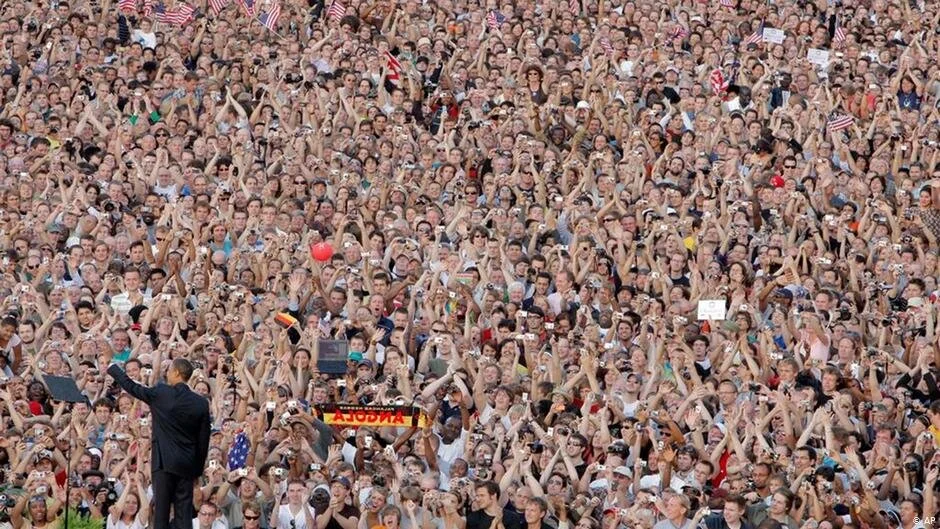
Twelve years ago, then presidential candidate Barack Obama athletically ascended some steps and waved to a crowd of hundreds of thousands of Berliners (some reports claimed one million) in front of the famous Brandenburg Gate and gave them their first taste of what appeared to be a different world, a different future, a different America.
It was a gamble, since hardly anyone had heard of him scarcely a year before. He was just a four-year junior senator from Illinois, yet had won the Democratic nomination and was now in a fight for the presidency. “What if nobody comes?” he asked seriously, on the plane from Tel Aviv to Berlin.
He needn’t have been concerned. Crowds lined the roads from the airport and gathered in the thousands outside his hotel prior to the speech. It was clear something was going on.
On that same plane trip, he and his staff had considered the implications of his journey. In Israel the day before, talk had been of the Holocaust and its seminal effect on human history. And now they were going to Berlin, Germany, where Adolf Hitler had masterminded the Final Solution, resulting in six million Jews killed.
“How could the Germans have done it?” asked Benjamin Rhodes, Obama’s key speechwriter. “At the time they were the most civilized of people.”
He was asking that question a time when the world seemed remarkably uncivilized. The Iraq and Afghan wars raged on and George W. Bush was in his final months as president. Tensions were growing in Asia and the global economy was about to tank in what was about to be called the “Great Recession.”
Now Obama had the opportunity to speak out against the downward slide. What he hadn’t anticipated was just how much Germans, Europeans, Asians, Canadians and Americans were pining for something different than what they had just endured. Obama couldn’t be sure the moment was right – until he saw the endless sea of faces before him on a hot Berlin day.
He had been cognizant of John Kennedy’s infamous speech nearby in 1963, when the youthful president delighted the crowd by declaring: “ilch bin ein Berliner” – “I am a Berliner.” That was a time when the city was split in two – West and East – and the Cold War was ramping up. Kennedy called for something better and declared himself part of the solution.
Then Ronald Regan had done something similar, concluding his epic remarks with the challenge, “Mr. Gorbachev, tear down this wall.”
They had both been presidents, but this young black American wasn’t quite there yet. Nevertheless, he had the pull of a rock star and a first-rate mind. He was watching as the world retreated behind the old walls of racism, religion, nationalism, from global order and, worst of all, from hope. He spoke directly to the heart of the issue.
“The walls between old allies on either side of the Atlantic cannot stand.”
“The walls between those countries with the most and those with the least cannot stand.”
“The walls between races, tribes, natives and immigrants, Christian and Muslim and Jew cannot stand.”
The crowd was erupting in spontaneous and seemingly never-ending applause, forcing Obama to raise his voice in conclusion. “These now are the walls we must tear down. Our destiny isn’t written for us; it’s written by us.”
It was a different era. And it was a different America. Obama spoke of the “Candy Bombers” – American planes flying over parts of Berlin the Soviets had secured immediately following World War Two and dropping food for starving families and candy for children. This was the America Obama believed in – transcending boundaries in order to bring the world together.
Now there are forces erecting walls everywhere and seeking to hide behind them – nation from nation, religion from religion, race from race, tyranny from freedom, exclusivity from openness. It goes further. It’s about political parties that can no longer come together for the common good. It’s about rich people securing themselves behind walls of gated security from the marginalized. It’s about police forces hiding behind walls of systems and refusing to reform. And now it is about COVID-19, that pits the individual pursuit over the collective good.
These are walls and they are everywhere, especially in our own minds. They develop out of fear and anxiety, insecurity and pride. They are erected through the angst provided by trauma and prejudice. The more we permit them to grow that harder it will be to reunite when the time right.
The problem with walls is that they keep us from that one resource we require to move forward – each other. Permit them to grow and we, some of the most civilized nations in history, could be capable of actions that could shame us in the future.