
The Strange Case of Adam Kinzinger
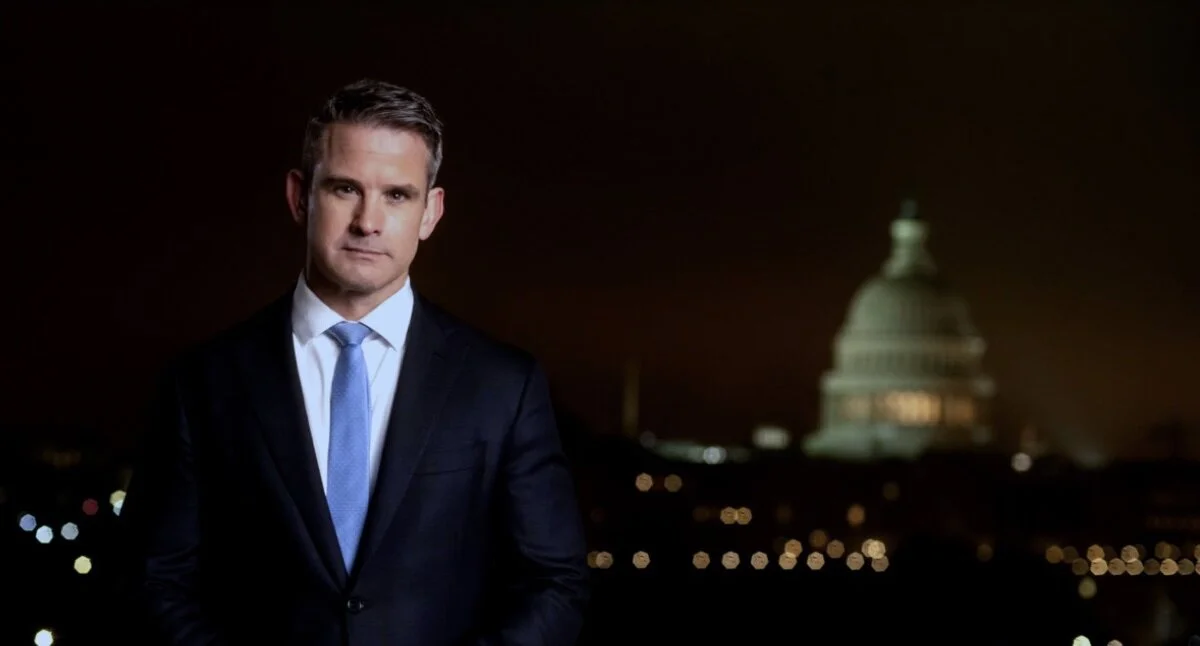
We say we want people of principle in public office, and if they are young and principled, all the better. We look for courage, the ability to speak directly to policy, to have an ethical backbone and an ability to work with others.
That is what the U.S. Congress has in Adam Kinzinger and for a time after his election in 2010, the Republican congressman from Illinois was one of the darlings of his party – one of a new wave of younger Republicans whose life exuded honour and duty to country and community.
It’s not hard to see why. He had been commissioned a 2nd Lieutenant in the U.S. Air Force in 2003, earning his pilot’s wings. He flew missions in South America, Guam, and Afghanistan and was stationed in Iraq twice, eventually being promoted to Lieutenant Colonel. So, yes, after all the soiled year of politics in America, he represented something different, a chance for a better kind of public service.
And then he uttered the words, “this is no time for silence” and everything changed. He had built a reputation on opposing some of the more outlandish actions of his party leader, Donald Trump. Media on both the Left and the Right were happy to speak of him (and flagrantly use him) as something different, something better.
But when he was one of seven Republicans calling for the impeachment of Trump and saying he was willing to convict, all that high highfalutin talk about principled politics was tossed out the window. And that’s because when push comes to shove, for so many rampant lovers of politics, “principled” is really just another word for “party”. All that military service, the bravery, the ethical clarity, the youth, the patriotism means little if those against you are blindly tribal.
And, yet, living up to those traits is still at the core of Kinzinger’s present actions. Despite the opposition from within, he still maintains it is time to reclaim the Republican Party from its caustic fringe elements. In fact, he’s calling it a movement, designed to repel the conspiracy theorists who have infested much of the party. To date, he is one of only a few Republicans to denounce such theories.
So, yes, there’s a lot to like about someone willing to stand for something and not just against something.
Until we realize what it has cost him. True, some in his party have called for him to be sanctioned, or removed altogether. “If they try to take action against me, that will be pretty telling,” he says. That’s true, but it appears the opposition is now a lot closer to home. This week, he received a letter from 17 family members, saying how disappointed they were with him, that he was no longer one of them and that he was being disowned. Those signing the letter were Trump supporters and it seems that supporting the former president’s calls for these kinds of extreme actions has become the norm in much of politics.
How does Kinzinger feel about it?
“My dad's cousins sent me a petition — a certified letter — saying they disowned me because I'm in 'the devil's army' now. It's been crazy, when you have friends — that you thought were good friends that would love you no matter what — that don't.”
There is nothing wrong with being loyal to a political party, or to a sports team, or to a certain faith. Our parents and grandparents did it for decades, but it never became this – at least not to such a vast degree that it occupied the national dialogue for years at a time. I recall hearing someone observe a long time ago that the worst thing you can do with an individual full of prejudice is to give them a Bible. It would seem that it holds true in this story as well: the consequences can be direct if you provide a hater with a political party. The fault lies not in the scripture or the Republican party, but in the individuals who use such advantages to encapsulate their own extremes.
This is now what an ideal candidate for his party now faces. Adam Kinzinger knows the stakes. As one of his colleagues noted, he isn’t fearful of being on the firing lines. It’s just that it’s become so personal, so eccentric, so divisive. The very thing he is endeavouring to keep from taking over his party is now directing its salvos at him, including members of his own family.
He knows it won’t let up. Winston Churchill noted, ““A fanatic is one who can't change his mind and won't change the subject,” and Kinsinger acknowledges this won’t go away anytime soon. But this is what politics can descend to when it makes room at the highest levels and the most intimate levels, for a kind of public spirit that has little of “public” or “spirit” in it. Politics deserves better. In fact, its needs men and women like the Representative from Illinois right now more than ever.