
Cool Before It Was Cool
Most of us recall the time Africa suddenly became cool. It was July 13, 1985 – almost 34 years to the day – that Bob Geldof and Midge Ure produced two vast venues, one in England and the other in America, broadcast simultaneously and designed to raise funds for the famine in Ethiopia. Almost all the famous rock celebrities gathered and performed their best-known songs, broadcast to two billion people in 150 nations. Those events pushed the “reset” button when it came to Western foreign policy and suddenly Africa, its problems and marvellous people, hit the global spotlight.
Lost in all that attention was an entertainer, born in England but living in South Africa, who had been telling Apartheid’s story and the human right injustices in music performed since the early-1970s. By the time Live Aid occurred, he was already a staple in Johannesburg and beyond.
Johnny Clegg died of cancer yesterday, only 66-years old, but his legacy spans decades. Born to an English father and Rhodesian mother in Lancashire, England, Clegg was educated as an anthropologist yet pursued his great love of music. He eventually moved to South Africa and struck up a lasting friendship with Sipho Mchunu, a local favourite and talented singer. They formed the group Juluka – a multiracial band unique for its time and dedicated to speaking out against apartheid.
Johnny Clegg also flourished in a solo career, touring Europe, America and other countries in his crusade against the punishing racial regime in South Africa. He raised awareness like few others and was given the popular name "Le Zoulou Blanc" (the white Zulu). He formed a lasting friendship with Nelson Mandela that benefitted both. While performing in Paris in 1999, Nelson Mandela surprised Clegg by suddenly appearing on stage and dancing with him and the band.
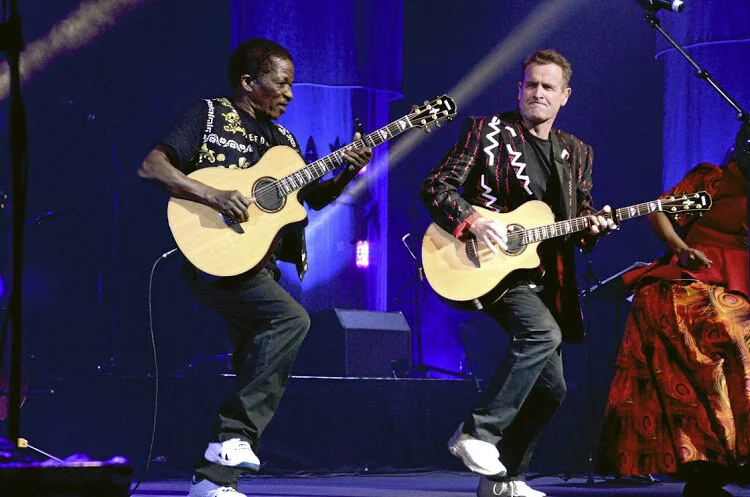
Clegg was known for his energizing concerts and his own love for African dancing, frequently bringing Zulu dancers on stage and then vigorously moving about with them. A mixed-race group was extremely rare in those earlier years, blending, as it did, Western and African music and lyrics. There was no real music genre for Clegg to fit into and so no record label saw fit to record his early work. Still, his live concerts were smash events bringing whites and blacks together in public demonstrations of solidarity that flew directly in the face of the government security forces.
I was introduced to Johnny Clegg by my wife Jane, who was schooled in South Africa in the days of apartheid and returned to Canada with a social justice bent that found its musical voice with people like Clegg and her motivation through the words of Mandela and Desmond Tutu. Clegg’s songs, like “Scatterings of Africa” and my favourite, “Asimbonanga” have become part of my own collection of staples. Hs voice and music frequently fill our home with their sense of hope, diversity and dedication.

Johnny Clegg received a long list of honours during his career, including the Order of the British Empire and Knight of Arts and Letters by the government of France, yet he remains an unknown to millions who care about Africa’s future and yet haven’t heard of this remarkable pioneer who preceded more well-known luminaries like Paul Simon, Bob Geldof, Bono and Toto. He was cool before it as cool, especially for those in South Africa who suffered under the burden of unjust racial policies. To listen to his songs now provides a moving backdrop to the great African movement towards equality. It is music geared to last generations, just as it will with our own children and grandchildren.