
"The Forest Secret" - Chapter 19
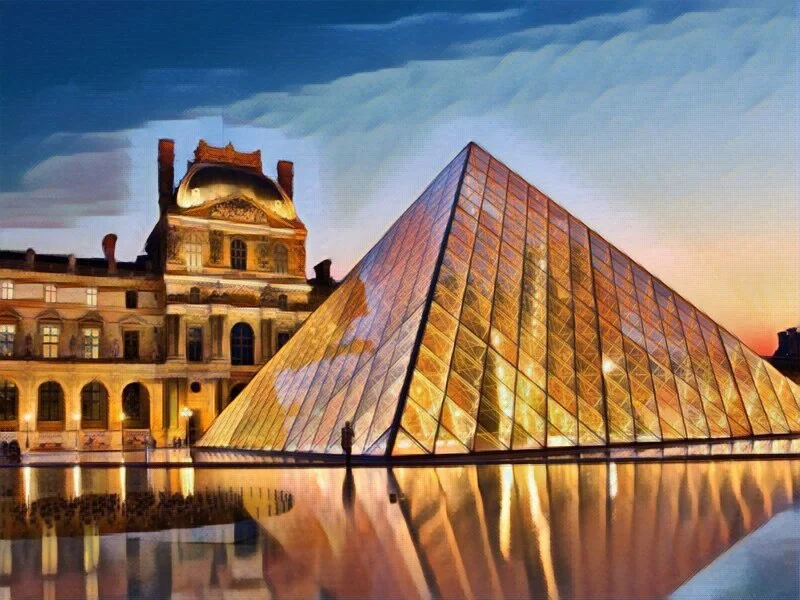
One hour later the entire group, except for the female security officer, was in a climate-controlled vault in the basement of the Louvre - the most famous art gallery in the world, holding almost half a million pieces of art, including sculptures and paintings.
As soon as the official from the Minister’s office saw what the painting was, he was overcome with shock. Recovering quickly, he telephoned on his cell for a special van to be dispatched from the Louvre to pick them up at the cathedral. The vehicle was climate controlled, and unmarked, and its seasoned driver got them to the nearby gallery within 10 minutes.
They proceeded to the examination and restoration wing after passing through security. Then they waited while a room was brought to the appropriate temperature, humidity, and air pressure for examination of the painting.
Over 60 curators worked at the Louvre on any given day, covering eight major departments in the massive structure. Two of those curators, one for findings and the other for validation of art pieces, joined them. They waited for another 20 minutes as Minister of Culture Jean Moreau quickly made his way from an event on the outskirts of Paris.
All of this was taking place without any of the journalists, or Mary Weatherby, having any clear idea of what was happening. It seemed certain that the painting was an important work of art, but none of the officials was willing to comment until the piece had been examined. It was all very surreal. For the impatient journalists, understanding that they might be on the verge of a major scoop, it was maddening.
At last the Minister came in with a rush, as perplexed as anyone else as to why he had been called away on such short notice. The round of introductions was made, with Bernard and the Minister kissing on each cheek, as is the French custom for fond friendship. That being concluded, the ministry official proceeded to explain the unusual events.
“Thank you for coming,” he began. “I accompanied these people to the upper chamber of the cathedral at your request, Minister, not really knowing what to expect. Truthfully I was dubious.
“Until I saw this,” he continued, looking down at the long narrow case. “I wonder if one of the curators would please remove the canvas from the box and lay it out on the table for us?”
Both curators came forward, pulling their latex gloves on in practiced fashion. One held the box while the other pulled out the lid and lifted the canvas. Both then put it on the glass table and gently unrolled it to reveal the figure of what appeared to be an angel looking down and to its left, with the outline of a halo and spread wings. Long curly hair spiralled down to the figure’s shoulders, and its robe appeared to be of fine shimmering silk.
The curators were deathly silent and still. They didn’t touch the canvas, other than to keep it from naturally rolling up, but their eyes caressed it like a lover. The others admired the careful strokes and strange luminescence of the background, but had no workable knowledge to understand why it was so important
Mary’s eyes pored over it, misting up as she recalled how she and Aramis had first stolen it from the shelf and then sequestered it to the beam. In all of the recklessness of the act and the care taken in its concealment, they had never once looked at their treasure. She was now seeing it for the first time, its beauty easily conveying the memories of the past to the wonder of this present moment.
The two curators spent a full minute scrutinizing the lower part of the painting, and seemed to nod in unison. Then they turned to the others in the room and politely asked them to assemble in the room down the hall, where they would join them shortly.
While waiting at the long conference table, there was little small talk. The conversation was mostly about the identity of the piece and how it came to be hidden in the cathedral’s peak. Both Moreau and Bernard kept the talk going with ease. But all were preoccupied with two questions: what was so important about the canvas? and why was there so much secrecy surrounding it?
When the curators entered the room, they carried a large photograph of the piece they had all just seen, likely taken a few minutes earlier in special lighting conditions so as not to damage the original. They placed it on the table in front of their visitors.
“We believe we have identified the piece,” one of them said. “If examination stands up, it is An Angel With Titus’ Features.”
“Non,”a voice gasped from the end of the table. It was Minister Moreau. After a moment, he addressed the others.
“This is a masterpiece that was stolen in 1943 and apparently stored in a Paris warehouse. After the war the trail went cold and it was never discovered. It was presumed destroyed or sitting in some wealthy collector’s stash somewhere. There were 352 of such works stolen by the Nazis but only 162 have been found - 163 now, should this be genuine. It was Hitler’s dream to create a museum and cultural centre in his hometown of Linz and convert the city into Austria’s capital, because he hated Vienna. All we had was a poor black and white photo of this piece to go by for all these years.”
“So, it’s an angel?” Bernard pressed.
“Yes and no,” Moreau responded. “It is the face of the painter’s son Titus. The painter was famous for such portraits but this one gained much attention following the war because it had been stolen from a famous French family’s chateau in the country.”
“So the son was named Titus,” Bernard noted. “But who was the painter, the father?”
For the first time, Denis spoke in a whisper: “The father was Rembrandt - Rembrandt Harmenszoon van Rijn.”
A collective gasp filled the silence in the room.