
Our Way Back
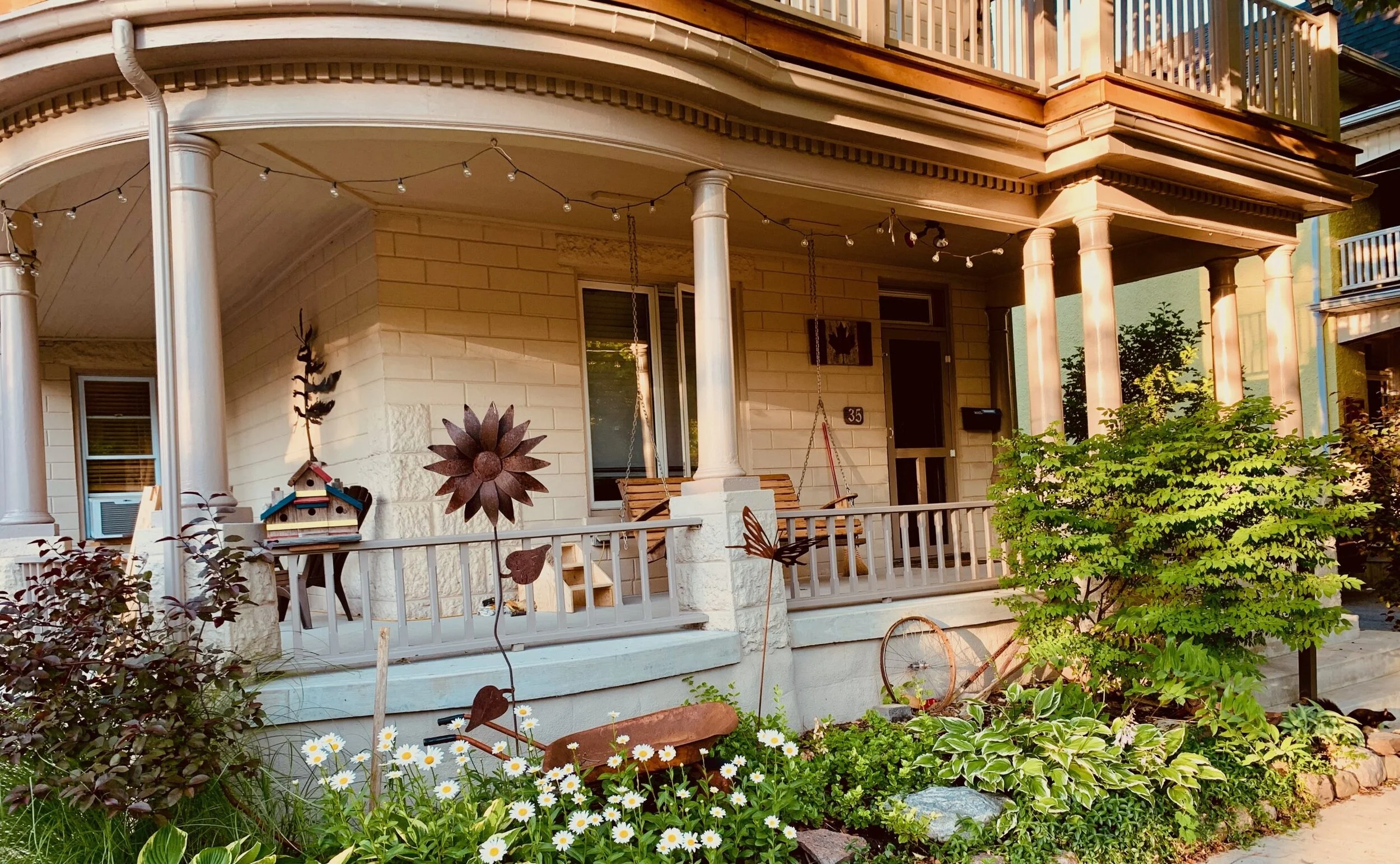
Our homes have become our sanctuaries in this pandemic, that one place we feel we can control the comings and goings and feel protected against a virus we can’t either see or fully understand. We pine for going out dining or shopping but are aware of social restrictions for our benefit and that of others, so, our homes become our centre as never before.
But there is that one place for many, where we can venture outside enough to feel somewhat connected yet at the same time remain secure – our porches. Not everyone has one, but for those fortunate enough, a porch, as opposed to a back yard, becomes a place of encounter, of connection, of at least being part of the larger world.
It’s no accident that people feel lonelier, more isolated, during COVID-19 – a reality that has led to its own kind of isolation pandemic. Masks remove our ability to smile at others. Not being able to hug or give a handshake makes us feel less than human sometimes. And remaining six feet apart even from those around us seems to take the “neighbour” part out of neighbourhood.
In a past age, porches were extensions of the home out into community and also provided a kind of landing ground where those living around us could find common ground without necessarily having to enter the home. Porch furniture carried a kind of intimacy – swings, laid back Adirondack chairs, cushions, decorative lights and even candles. It moved that part of the home’s welcome out towards the street where neighbourhoods moved towards us and we edged closer to them. Above all, a busy and welcoming porch said that we were open for community and aware of the nearness of citizenship.
That last bit is important. Our porches represent possibilities that wouldn’t exist without them. They make us more neighbourly, community-minded, and aware. It’s from those porches than we watch others walking by, where we sit out during the rain and get closer to the natural order, and where we escape the confines of the home to move out a bit more into a larger world. They are the places where we become more engaged and engaging – the staging grounds for our emotional, spiritual and physical embrace of our community.
We just happen to live in a portion of London, Ontario called Old South – streets replete with porches of all sizes and shapes. Part of the reason people walk so much through the community is just to observe how others fashion their porches, their gardens, their lives. Where people in New York City used to stroll down 5th Avenue for the Easter Parade, our community does it every day, especially as the welcoming rays of the sun match the openness of the front porches. Along the way, people encounter one another and make that vital move towards neighbourliness.
There was a time, for a few decades at least, where the back yard emerged as the key gathering point of the family. The world was becoming more alienating and people retreated to the confines of their homes to get away from life’s daily pressures. The family and not the neighbourhood became the focus of domestic life outdoors. We were effectively cutting ourselves off from one another with the excuse of escaping the rat race. There was merit in it, yet something was lost in that transition from the front to the back, from shared lawns and gardens to fences.
But we are now on our way back. A new renaissance is emerging, one in which we have come to understand that “connectivity” is something to be valued, not shunned, especially if it leads to the enhancement and growth of the civic virtues that were once so important to citizenship and democracy. Families are beginning to “take back” their neighbourhoods and in some many cases they are using their front porches as beachheads for their rebuilding of civility. They are telling their world that they want to be a greater part of it, to see it, to smell it, to embrace it, and, above all, to shape it.
Our porches have become us – that more sociable dimension of our human spirit that says will can fight the isolating encroachment of a pandemic by extending ourselves into our communities by way of our porches. In its own way, it forms the migration of humanity back to itself.