
Our Economic Future is Nothing to Sneeze At
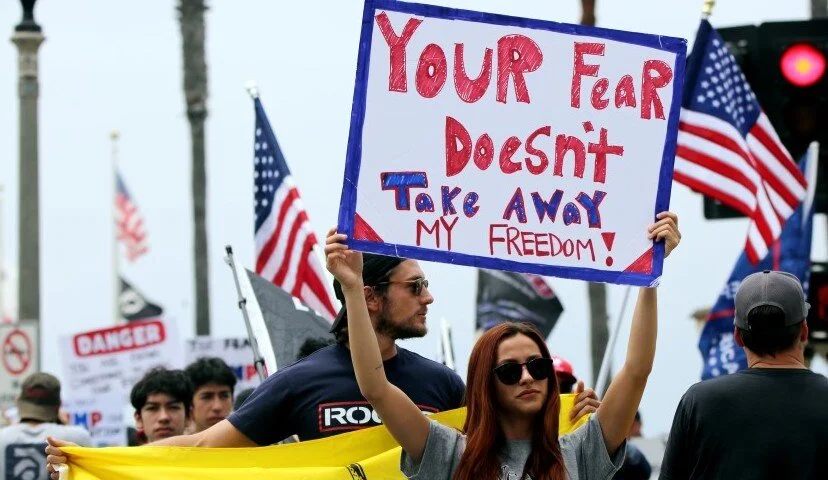
It’s been a season of contradictions: wear a mask or don’t wear a mask; open the economy or keep it closed; it’s okay to gather in public or it isn’t; the pandemic isn’t that big a deal or it’s catastrophic; listen to the health experts or cater to the uninformed.
In a time of little certainty, options and mistruths are many. Or as American founder Benjamin Franklin would observe in his The Way to Wealth: “The people heard it, and approved the doctrine, and immediately practiced the contrary.” Every global leader is living through that experience at this moment and every political calculation is a gamble with the unknown.
Somehow, two key components of modern life have been turned from allies into competitors – public health or the economy. It played out early in the pandemic, when some wondered whether it wasn’t best to let seniors perish if it meant the economy could open. That debate has continued in various emanations throughout this entire emergency.
The reasoning seems clear enough. If you continue to limit public mobility or keep people self-isolating or social distancing, then the economy can’t recover effectively and we’ll all be in the financial soup. The longer it goes on, the starker this reality becomes. Either ruin the economy or permit thousands, perhaps millions, to perish. It’s a diabolical choice that no one even thought about five months ago. Whichever way this turns, the costs are huge. A report from the Washington Post reveals that the White House itself is basing at least some of its plans on British research that suggests at least 2.2 million Americans could die over the next few months if more controls aren’t enacted.
But the economic implications are just as dire. The UCLA business school maintains that continuing social isolation guidelines will cost America some 2.2 million jobs in that same time frame of the next few months if steps aren’t taken to open the economy. Whichever way you cut it, the choice is stark.
In the midst of all this emerged a voice of clarity, when Jason Furman, once an economic head in the Obama administration and now a teacher at Harvard, proclaimed that the choice was actually an easy one:
“There’s no time to do careful cost-benefit analysis on this. Follow a simple rule: Anything the health people want to do to save lives they should do. Then the economic people can do what they can to mitigate the damage.”
Many significant economic voices will disagree with this, naturally, but it’s looking increasingly like this will be the only choice left for decision makers. Viruses always behave the same. They continue to contaminate until they run of hosts, at which point they weaken. In some cases, however, unlike the common cold, a virus can be a new variety, like COVID-19, and there is no immunity yet developed for it. Public health officials largely agree that the virus will continue to spread until it reaches about 80% of a population, when “herd immunity” takes effect, or until an effective vaccine comes online. Until that happens, the economy can never be what it was and will always remain one of the victims of a virus that has already gutted much of its potential.
After all this debate about the economy or public health, it turns out that there is no trade-off, no one or the other. We hear consistently from economic voices that if we don’t open the economy soon, things will become devastated. But, and this is vital, as Cambridge University has cautioned from its latest research, the economic cost of reopening the economy too soon will be double what it is now. In other words, we will ruin our economic future if all we do is tend to it instead of our public health crisis.
In its own way, it makes sense. Should we grow tardy in our public health efforts, or lazy in our social watchfulness, a vicious return of the pandemic will be inevitable. Only this time, more businesses won’t survive, since they have already depleted their reserves during the first round. More people will lose their jobs in consequence. It is inevitable because the spread of the virus is inevitable, unless contained at all costs.
Let’s put it another way that some won’t like: without maintaining an effective lockdown and social distancing, the economic damage will grow far worse than it is now. That is the troubling and stark reality.
Until now, the assumption has been that only by opening the economy can we possibly get it back up and running. But if it’s true that doing so, at the expense of proper public health controls, means the economy could be further ruined, where is the logic in moving ahead?
We know this is happening south of the border, and we are discovering that the great temptation of placing economy over health will only hurt the economy further and consequently hinder its future capacity to return when the vaccine is distributed. If we don’t check the disease, then its effects will move from economic sector to economic sector, until the economy’s very ability to rebuild itself becomes suspect.
“We seemed to have arrived at a reality only to abandon it or exchange it for something that claimed to be another reality,” wrote author Gunter Grass of another era. We are now doing it again, veering back and forth between the economy and health. Ultimately, there is no contradiction here. Either prioritize health action or witness our economy get worse. The economy’s only hope lies in the vibrancy of humans not on the markets.