
A Google Gem
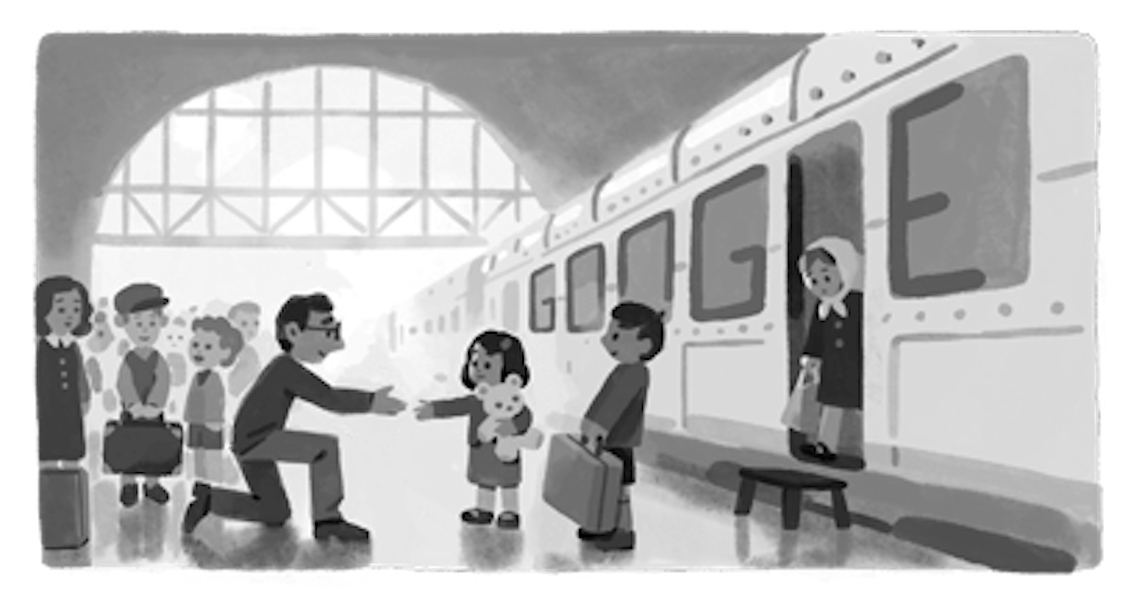
Recall this image from Google earlier this week? I clicked on it because I was curious with the depiction of two small kids getting off a train and being compassionately greeted by others. That click opened up a new dramatic story for me, one that I hadn’t known but which I found inspiring, especially in a time of change.
Nicholas Winton, a British humanitarian, said nothing about his remarkable story, which many conclude as similar to the better-known stories of Raoul Wallenberg and Oskar Schindler. It was his wife’s discovering a dusty scrapbook in their attic in 1988, which listed vital information about 669 mostly Jewish children from Czechoslovakia who were rushed out of the country on the eve of World War Two through Winton’s timely energies. These were children destined for German concentration camps, but were instead spirited away just in time through the help of their parents who inevitably perished tragically in those same camps.
Winton was on his way to a skiing trip in Switzerland but cancelled at the last minute when a friend asked him for help with refugees hoping to escape Czechoslovakia, now that it was annexed by Germany and about to deport thousands to “detainment” camps. What Winton subsequently discovered prompted him to undertake a remarkable drama of courage and compassion.
As the New York Times recounted it a number of years ago:
Mr. Winton created an enterprise that involved dangers, bribes, forgery, secret contacts with the Gestapo, nine railroad trains, an avalanche of paperwork and a lot of money. Nazi agents started following him. In his Prague hotel room, he met terrified parents desperate to get their children to safety, although it meant surrendering them to strangers in a foreign land.
He knew he had little time to waste, and while leaving two of his friends in Prague to help document and organize the escape on the ground, he journeyed back to Britain to begin the arduous process of finding foster homes, raising sufficient money and arranging adequate transportation for the children.
Hundreds of families quickly signed up to take the children, but government bureaucracy didn’t move that quickly and it was then that Winton engineered a truly dramatic and radical act: he forged entry permits for the kids, since they would be lost forever in the Nazi machine if he didn’t do something quickly. It was an audacious act.
But it didn’t happen in isolation. In Prague, the friends wooed the chief of the Gestapo, who assisted with forged transport papers, along with bribes, to be given to key rail officials, who inevitably stopped the trains and pressed for compensation if they were to proceed. Many of the families who remained and were to ultimately be exterminated sold their possessions to help fund their children’s escape. The red tape was endless and required a determination of remarkable diligence to overcome.
The eventual farewell between families is infused with remarkable tales of sacrifice, humanity, with rescue for some children and the extermination of others. After escaping through Germany, then Holland and across the sea, the trains were met in a London station by the host families. Each child only carried one bag and wore a name tag, the memories of their separation days earlier surely seared into their brains.
But it wasn’t all good news. While 7 trains carried the children to safety, an 8th train was stopped just as Hitler invaded and those 250 children were never heard from again. It’s believed they perished in concentration camps – a reality that haunted Winton for the remainder of his life.
I found myself wondering how an adventure like that could go unknown for decades. Most of those kids are in their 70s and 80s now and surely recounted their own personal dramas and called themselves “Winton’s children,” yet the story didn’t emerge until Mrs. Winton’s made her discovery that day in the attic – some 50 years later. Another remarkable component of this story is that his wife of many years had no idea of her husband’s exploits. She perused through the documents, eventually confronting her husband, requesting that he tell her. What came out of his mouth in the next few hours and days filled her with wonder.
Some of those children went on to have distinguished careers. One, Joe Schlesinger, became a well-known CBC journalist, who died a short while ago.
Nicholas Winton was 106 when he died, but along the way he was knighted by Queen Elizabeth II in 2003 and was awarded many distinguished medals around the world after his story emerged. The scrapbook now resides in a Holocaust memorial in Israel, streets and schools have been named after him, and statues of him sit in Prague and London, England.
It is a story that is truly remarkable, but I found the most intriguing aspect was the sheer humility of it. When asked why he never told others of his exploits, or showed the scrapbook to anyone, he replied simply, “I did not think for one moment that they would be of interest to anyone so long after it happened.” Those who knew him spoke often that he was a man of humility. Until the very end, he was incredulous concerning the plaudits he received. He often said that he had a “duty” to respond once he heard of the children and that somehow a Swiss vacation didn’t match up to that challenge.
This story deeply moving and I realized part of that was because we have been living through a situation in my own city where literally thousands of people every day are sacrificing their hours, their money, their gifts and talents, to help their community get through something they have never been through before. Are their efforts as great as Winton’s? Does it matter? We are each called to a similar “duty” and so many have taken it seriously enough to dedicate their service to others. Perhaps they, too, would be astounded at just how much their efforts would register with others if they were eventually documented.
“It's not hard to decide what you want your life to be about. What's hard is figuring out what you're willing to give up in order to do the things you really care about,” said Shauna Niequist. Right now, we see a lot of this in our communities and it’s a beautiful thing.