
Policy or People: the Chicken or the Egg
Public policy is pivotal. It is essential to how we carry out our dealings with one another as a people and it provides a hint of what our shared values are. Or at least what we say. That’s a crucial distinction. If we really mean what we say, then policies will be supported that put substance to our aspirations. Or we might think we mean what we say but fail to support it and the shallowness of our value system is exposed to all.
Sadly, we live in such times when we don’t deliver on what we boast that we believe in. The polls tell the tale. Canadians, by vast majorities, affirm that they want to end poverty, effectively combat climate change, achieve true gender equality, desire to be a shining example the world or have thriving communities. But we aren’t there yet, and in some cases have fallen farther behind. In such conditions, it is rare that our politics will rescue us from this dilemma. It’s the proverbial chicken and the egg. When that happens, it is the actions of a dedicated few that can show us what is still possible.
Right now, Canadians are bemoaning what is transpiring in the Amazonian forests. We know the figures. We know that action, perhaps severe, must be taken to rescue what is left. And we have no doubt that a deadly mixture of corporate greed and a blind politics lies at the root of why it is all happening, especially in Brazil. The recent G7 meeting in France couldn’t find the collective will to take effective action on the devastation, other than donating a few million dollars to fight the fires. Meanwhile the destruction continues unabated and policy flunks again.
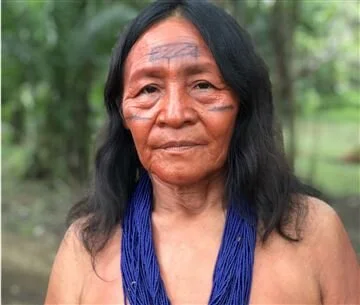
In such moments, it is often the action of individuals that tackle the problems head-on. An NBC story tells of one such pivotal figure when it encountered into 59-year old Ajareaty Waiapi, a female chief in the Amazon and grandmother working to preserve her community. Her words are strikingly similar to what was broadcast at the G7 by leaders she’ll never meet: “If the forest is gone, people will also end.” The difference is that that Waiapi is committing everything she has to the effort.
She is attending high school to gain a better knowledge of the unique Amazonian ecosystem. She is facing the problem through her own personal experience. Wildfires are raging near her village and most believe they were started by illegal cattle ranchers and loggers who are allied with the Brazilian president. In other words, Waiapi is up against her own political system, the apathy of the world community and the rampant greed of corporatism. And yet she continues – a valiant example of an indigenous woman taking on the world.
In only a few months, the president has taken down Brazil’s agencies charged with protecting the rainforests. We somewhat understand what this will mean for the rest of the planet, as these forests provide 20% of the planet’s oxygen, but for Waiapi it represents the end of her civilization. So, she learned Portuguese in order to speak to the decision makers and has even travelled to Europe in an attempt to stop the insanity. She’s intelligent enough to know that the battle is bigger than whatever her own people do to fight it.
Like the American president, Brazil’s version is moving on a fast-track to stimulate his country’s economy by rolling back years of environmental stewardship in order to get to precious mineral resources hidden in the forests. “Let’s use the riches that God gave us for the well-being of our population,” he calls out at rallies. By “population” he means the elite class of Brazil, of course. For Waiapi and her people, well, they’re on their own.
Ironically, until 1973, no one had made contact with Ajareaty and her people. Now, in only a few decades, they could be wiped out, along with a culture that has existed for millennia. But it was only in 1996 that the government voted to protect the lands by law. In other words, public policy had come to the forest’s defense as the world ratcheted up its endeavours to heal the planet. Such protections were even put under the constitution. Now that same policy has been voted down and it seems that all that is left are people like Ajareaty Waiapi, her people, and a few global defenders.
She has few tools at her disposal, but what she does possess has endured for generations: culture, lore, stories, courage. She travels around to villages, gathers the women together, and gets them to join hands as they sing a traditional song for the butterfly. Their legend maintains the butterflies endlessly fly through the forests, tying invisible strings that hold the planet in place. It is a beautiful image. Sadly, those same butterflies are being wiped out by all the fires.
What must Ajareaty Waiapi think of us? Her education has taught her about the rest of the world and she has learned of our wealth. And yet she has heard of the great G7 summit in France and the lack of willingness to use legislative might to help her people. She knows well enough that if these fires were happening in California or the Black Forest of Germany billions would be spent on the problem.
In J. K. Rowling’s Harry Potter and the Sorcerer’s Stone,Harry is reminded of a truth that was in its own way disconcerting: “It takes a great deal of bravery to stand up to our enemies, but just as much to stand up to our friends.” This isn’t merely a story of one remarkable woman standing up for her people, but of the failure of the people of the world – her friends – to press for the change required to help her achieve it. But then again, we are lost in our own struggles about how to agree on a carbon tax. She looks to us in vain. Yet we look to her for inspiration and if policies change, it will because people like Ajareaty Waiapi reminds us of what the human spirit is capable of and that our policies are the means whereby we collectively carry it out.