
Tiananmen Square in Reverse
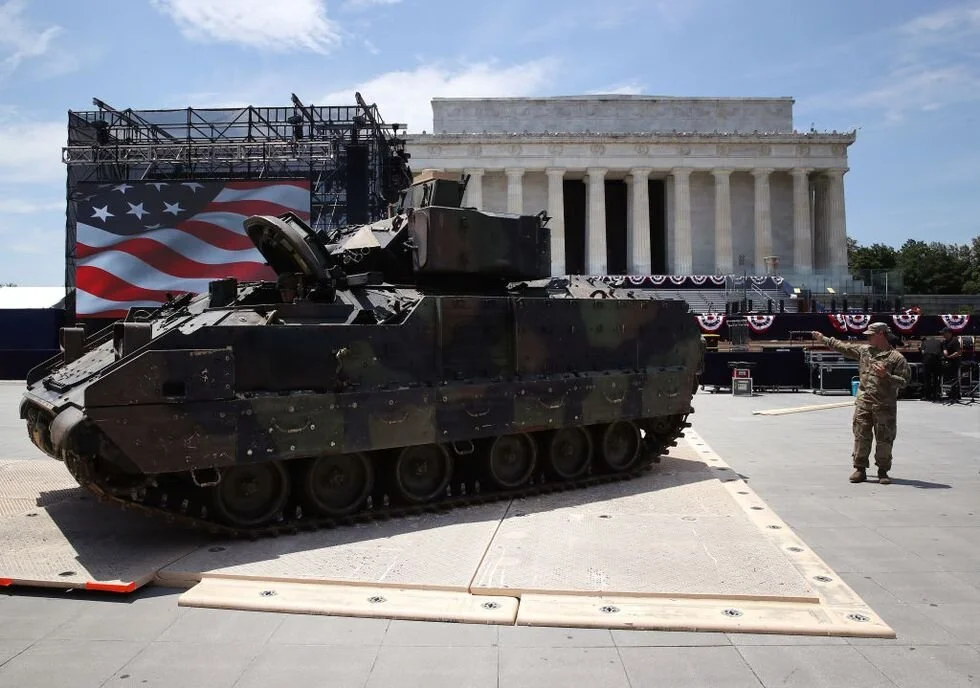
Like many others I suppose, the sight of military might in the streets of Washington D.C. yesterday brought on a series of conflictive emotions. This was Washington as I had never witnessed it. Such celebration has had its place in the country’s history, but this was different. The Guardianaptly called it “tank watch,” as citizens and media began reporting on military hardware coursing through the streets of Washington during the night hours.
Something didn’t seem right about it. True, America for most of its existence has been a dominant military player, but that might was always overseen by political forces who knew when to use it and when to put it back in the box. We shouldn’t be surprised that many Americans were upset by what took place yesterday. All those thousands of parades, ball games, ceremonies, dances, fireworks, speeches and spoken memories suddenly became eclipsed by Donald Trump’s display of braggadocio. The sight of military vehicles in from of the Lincoln Memorial was just too much. For two days, military leaders did the media rounds, giving countless interviews in their attempt to assure citizens that there was nothing to fear. Many of those same leaders quietly questioned the propriety of even considering such a display.
But that wasn’t what troubled me. Rather, it was about a number of other developments that served as a darkened backdrop to all those tanks, support vehicles, jets and troops. In this particular period in the modern era, a time when authoritarianism is not only on the rise but prevailing in various parts of the world while democracy falls into decline, this might not have been the right message to send, even to Americans themselves.
There are other things, too, that we need to consider. Suddenly we are back in the days of detention camps, where the sight of families, kids especially, locked up in cages, short on food and water, and existing in decrepid conditions. Arguing as to whether such individuals should be permitted across the border is one thing, but to treat them with such clear inhumanity speaks of something else altogether. The sight of bodies in a river or of kids separated from their parents for lengthy periods of time has run completely counter to how America has sought to present itself as a humanitarian force for good in the world.
And then there is the rise of Nazism in the country, which most thought they would never encounter again. Ben Ferencz is now 99 years old and the last living prosecutor of the Nuremberg trials – aptly termed the largest murder trial ever. He is presently raising the alarm, stating that some parts of the world are behaving just like the Nazis, including certain aspects of America. That’s a troubling thought.
Then there’s the recent upsurge in the “us” versus “them” dialogue south of the border, even labelling some as enemies of America simply because they are different. The legitimate fears regarding immigration are all too frequently drowned out by the rhetoric, especially when it comes to people arriving in the United States legally from other parts of the world.
There’s more, much more, that individually can be off-putting but which together cast a shadow over the President’s labelling the day as a “Salute to America.” As our cousins to the south, the United States has always had much to celebrate and Donald Trump’s speech attempted to honour that tradition by not going to extremes. But with all that is going on – the political turbulence, human rights violations, growing economic gap between the classes, the hate, the belligerence, losing of allies and the growing fear in America – the pumped-up military presence on the capital’s streets likely sent the wrong message in a time when the nation requires healing.
All this transpired almost 30 years to the day after the Tiananmen Square protests in China, where the image of one student defiantly standing before a column of tanks in the capital sparked hope for democracy worldwide. But that was different. It took place in a country where a brutal government sought to squelch the uprising so that democracy couldn’t gain a foothold. The displays yesterday in Washington were happening in a nation supposedly the leader of the democratic and free world. The unusual presence of military hardware on the streets, far from stimulating democratic vigor for many, instilled fear instead – Tiananmen Square in reverse.
Author Criss Jami insightfully wrote, “A fear of weakness only strengthens weakness.” In Washington yesterday, and around the country, a great many citizens sensed the presence of tanks and planes in the capital was an overreach – an attempt to mask over the inevitable sense that America is losing its qualities of moral leadership in the world. No amount of military hardware in the capital of the free can possibly accomplish what an open and just society, predicated on transparency and the rule of law, has done for over 200 years.