
"The Forest Secret" - Chapter 25
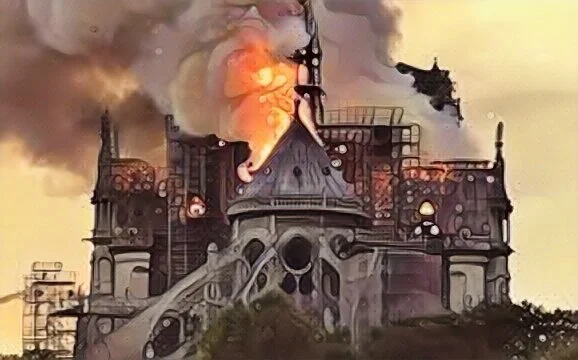
HUMANITY AMONG THE RUINS
by Charley Heron
His fate played out high in the ramparts 200 feet above while the thousands gathered below had no idea the solitary figure was there and enduring his final few seconds of life.
For those who knew him, the loss of Aramis Caron became as poignant a tragedy in Notre Dame Cathedral’s blaze last month as the charred remains of the spire and of the intricate wood and stone carvings that had stood and drawn people for centuries.
Why was this solitary figure in the building at the time of the fire? Later revelations would inform us that, far from being lost or disoriented in his advancing years, Caron purposely entered the structure during the worst of the inferno and deftly ascended to the Forest - the interconnected skeleton of massive oak beams responsible for supporting the ominous weight of lead tiles running across the entirety of the cathedral’s roof.
Again, why? It would have been obvious by that late hour just how dire the situation had become. Even when his body was surprisingly discovered during a damage assessment, partially charred and lying on one of the great crossbeams, answers weren’t forthcoming. His death became a passing mention in some media accounts, which opted instead to focus on the global response to the fire - outpourings of support from global leaders, countless prayers, intimate reflections of those who had visited the icon of European faith, photos of vacations to the area in previous times, and above all, the countless promises to rebuild.
What the world is in the process of learning is that the solitary actions of Aramis Caron on that fateful night prompted the revelation of a remarkable life, capped off by one of the great discoveries of the post-World War Two era. It should also be cause for deep introspection regarding the path our present generation is traveling upon.
* * *
It turns out that Aramis Caron was both a disciplined and an intrepid writer, an insightful observer of his life and times. A graduate of the University of the Sorbonne, one of Europe’s most elite educational institutions, Caron left 87 journals chronicling his life and insights - a vast resource that informed much of this article. These volumes were discovered as a combined team from New York Times Magazine and the newspaper’s Paris office happened upon them while visiting Caron’s apartment a few days following his death.
But there was more. A painting of a beautiful young woman, completed sometime in the 1960s, occupied a central place in the well-appointed living space. Who was she? Could she still be alive and perhaps provide more details on what was becoming a search for a remarkable man’s identity.
The trail of research and a personal visit led to the locating of Mary Weatherby in the south of England. Weatherby and Caron had formed a relationship in the era of Parisian liberation and experimental French Pop. The two, upon hearing that a painting stolen by the Nazis during the war years was hidden in a run-down Paris warehouse, broke into the structure and lifted the canvas directly from under the nose of the art thieves. Their intention was to turn their finding over to the authorities. To secure it in the meantime, the two lovers decided to hide the painting in Notre Dame Cathedral, the place where Caron would eventually become a tour guide for over four decades.
The exact location of the hiding place? In the Forest and its networked timbers. With the revived memories of their daring escapade decades ago, Mary Weatherby led the Timesteam, French ministry officials, and curators from the Louvre to the exact place of hiding - directly below the same timber where authorities discovered Caron’s body only a few days before.
As the world has since learned, that hidden canvas, immediately taken to the Louvre’s preservation vaults upon discovery, was identified as Angel with Titus’ Face- a depiction of his son by none other than Rembrandt. It was believed to have been destroyed or lost following the war. Neither Mary nor Aramis had taken the painting out of its protective sleeve before securing it in the Forest of Notre Dame. They had no idea they had just preserved a masterpiece.
Though their relationship was to come to a close by the end of that 1960s summer, what they left behind as an emblem of their spirit of love and adventure will now endure for the ages.
* * *
The source of all this was a man believed to have been a simple but dedicated guide of Notre Dame Cathedral. Yet when all of these events are put end to end, they appear as the workings of some kind of superhero capable of great exploits. What he was, it turns out, was someone we used to be.
With the loss of Mary decades earlier, Caron found a new love, and dedicated himself to all that she represented. Seen through the reflections within his journals, Notre Dame emerges as a beautiful, at times sensual, paragon - a testament to the hope of humanity. Her features were still refined, bold but subtle, divine yet human, alluring but intimidating - yet always eternal.
Had Caron, in his final breaths, been able to see the crowds gathered below in the plaza, candles lit by the thousands, with hymns and prayers ascending with the flames and smoke, he likely would have marveled at the contrariness of our age. His volumes make it clear that he wondered what had become of our progress and aspirations, our spiritual faith, and our care for one another.
He might have wondered where all those people were in recent years as the great Cathedral had become a tourist destination as opposed to a meeting place between the Divine and the human. He had already expressed on paper his disillusionment with France’s decision to become a secular Republic, leaving no place for religion in public life. The irony of thousands of people standing outside the fiery structure, praying and singing the lofty strains of Ave Maria, wouldn’t have been lost on him, had he been conscious enough to hear.
For the last number of years, Caron had been part of organized efforts to raise funds for Notre Dame’s renovations, part of which were to better fireproof the building. The results of such activities were dismal - only one-tenth of the resources required were raised in the past five years. This scenario had happened before as the cathedral began sagging under its own weight. Victor Hugo’s Hunchback of Notre Dame hadsaved the day, drawing attention to the building’s dilapidated condition through the story of the cathedral’s inhabitant, the tortured Quasimodo.
There was no Victor Hugo this time, yet it was the ultimate destruction of much of the structure that would result in its resurrection. What couldn’t be raised in the previous 24 months came in, and more, in just 24 hours. Already one billion euros have been pledged. For the practice of faith? For the love of God? For a place of ethical and moral adventure, supplication and forgiveness? Ultimately, no. It was being rescued as part of some kind of global sentiment, little understood, and to preserve its place as a tourist draw to the great City of Lights.
At the most recent World Economic Summit in Davos, Switzerland, global economic leaders reached out to the great faith communities, requesting a working partnership as they sought to direct more attention to the world’s poverty and injustices. The reason? The world’s great religions - Judaism, Islam, Hinduism, Buddhism, Christianity - were increasing exponentially.
But not here. Not in the West.
“Having lost our ability to direct our own future, we have turned from generosity to greed, from humanity to hate, from democracy to dystopia, from moral foundations to a kind of collective madness.”
This last sentence forms a direct quote from one of Caron’s entries, dated January 1, 2019 - a few months before his tragic passing.
Aramis Caron was a complex man of infinite passions, yet his habits and practices were simple and rudimentary. They were steadily ethical, generously forgiving, rooted in spirituality, and humble in practice. He maintained this kind of “essential humanity” for his entire life, even as he watched the world turning angry and alienated around him.
* * *
Aramis Caron’s exploits and motivations necessarily force us to address our era - what various commentators repeatedly term “the age of dystopia.”
The disquieting problems we have experienced in recent years - the rise of hate groups, our fear of “the other”, a politics always riven with the uneasiness of not being up to the task, the appearance of refugees on a record scale, our ineffectiveness in the face of climate change, the loss of work and of faith in the future - have exposed the global failure to realize the promises given to us regarding endless progress and wealth for all. Traditional ties, supports and restrictions have been left behind along with their assurances about a person’s self-worth and identity.
Was what we built together following the Second World War only an illusion? Was our equilibrium, our hegemony, really that fragile? Are we meant to endure a world where all social, political and economic forces determining our lives are opaque? Will we remain forever disconnected from one another, our future, ourselves?
Such questions are why we now require the Aramis Carons of the world. Traditional religions and philosophies used to offer most people an essential interpretation of the world, giving meaning to life and creating social ties through shared beliefs. There was a time when we respected institutions that defined the common good, while respecting our individual uniqueness. In our fear and disconnectedness, we have cast off such restraints in search of personal liberty and identity.
And where has that gotten us exactly? When no authority exists in matters of religion or politics or morals, people soon become frightened in the face of unlimited independence. With everything in a state of perpetual agitation, they become anxious and fatigued. Webecome anxious and fatigued.
As Caron would note, again in a later journal entry, “Despite all our differences, we have been herded, by the forces of our modern world, our capitalism, technologies and politics, into a common present where we all feel lost.” Or to quote Arendt: “All that is solid melts into air, all that is holy profaned.”
This is what Caron was worried was happening to his beloved cathedral and its capacity to provide us with a shared foundation, a common humanity. To his seasoned eye, despite our many connections to our past, history wasn’t being repeated, as many observers claim. It was, in fact, entering a new global age of unaccountable individualism whose future was no longer a sure thing. There remains a great, sometimes undisclosed, fear that our global elites have cast off the constraints of social democracy in their pursuit of power and wealth.
Are new technologies and digital resources helping us? Apparently not, as humanity undertakes its massive exodus into cyberspace and its emptiness, and away from those institutions and foundations that kept us together.
“All of these crises of modernity were once absorbed by our inherited social structures and had their harder edges rounded off” - again a direct Caron quote. But now we are directly exposed to these traumas, leaving us insecure and isolated at the same time. There is now this almost universal vexation of everyone with everyone else - a trait most easily discerned in social media. It poisons our civil societies and undermines our confidence in our shared future, leaving millions turning to unfeeling and uncaring authoritative figures in hopes for some stability, some clear direction instead of the incessant fog coming from everybody else.
We are now caught in an era of endless drift - a malaise born of the loss of religious and human faith, just as Caron fretted about. Institutions historically mediated our understanding of history and the pressures of life. They formed the reference points, our series of North Stars, that assisted in orienting all of humanity in all times. They are now fading.
* * *
We need to examine more penetratingly our complicity in the culture that stokes alienation and narcissism.
This is where Aramis Caron and the remarkably stable life he lived come in. He reminds us that the promises of our struggling modernity can’t be righted or overcome without those things that got us here. This practice of just casting off those ethical forces that restrained and refined us only leaves us more angry and alone. It has forever altered our individual and collective ways of navigating the world.
Caron was comfortable with his place in humanity, as long as the progressive path prepared from before remained intact, with its institutions, its ethical considerations, and our care for one another.
He had to manage many loves, disappointments and challenges in his life, but chose to do so through the institutions that had cradled and developed humanity.
It is no secret that he shared his romantic love with Mary Weatherby in Notre Dame Cathedral, or that he opted to protect one of the world’s great art treasures in its upper Forest. Aramis Caron wasn’t trapped in the fire that consumed much of the structure; he chose to be there, accepting the flames as the price he would pay for great love through sacrifice - for his promise to the future.
Notre Dame became the final and great love of Aramis Caron, not because it housed his great personal aspirations alone, but those of all humanity. It became the motherlode of everything he held dear, all held in one place, elevated somewhere between heaven and earth, and worthy of his best efforts.
In that moment when he required all he had trusted and believed in to perform his final act of sacrifice in the flames, they were at his disposal for the simple reason that he had never discarded them to history’s ash heap. He lived and died nobly for those things that were greater than himself and to which he would entrust future generations.
Of all the events that swirled around the fire at Notre Dame, this is its greatest lesson. It will endure, not as a building or tourist attraction, but as a lightning rod for all the good that we wish for this world and its future, and as a testament of our willingness to sacrifice ourselves to that great end.
Aramis Caron is what we once were and can be again, but only if we rediscover history’s essence through our greater lights and better angels amidst all this darkness and turbulence.
Compiled through the generous efforts of the New York and Paris offices.