
"The Forest Secret" - Chapter 23
Their arches ached following four hours of touring through the classic shops that formed a perimeter along the wide avenue running to and from the Champs-Élysées. Though they both complained of fatigue, neither woman would have wished it any other way. They laughed, assisted one another in trying on various outfits, even boots, and delighted in the indulgences offered by the tree-lined avenue that had lured shoppers to its broad walkways and wares for centuries.
They eventually sat down for lunch at Restaurant Le Sens Unique,one of the many establishments that offered average fare for above average prices. Stephanie worked on a pasta salad while Charley picked away at a cheese quiche.
“It’s funny,” she said at one point during the lunch. “On the plane coming over here, I thought all about visiting the choice spots while I was here and shopping just for the delight of walking the streets of Paris. But there was never really any time, was there? Everything was non-stop action from the moment I arrived.”
Her friend looked up in surprise. “I have no idea what you’re talking about. You got up into the Forest a few times, dined at the most exclusive apartment in Paris at the Eiffel Tower and were received into some of Louvre’s most important rooms that the public will never see.”
Charley smiled. “You’re right. Add to that Bernard’s office, that luscious apartment that belonged to Aramis, the Eurostar and Canterbury Cathedral. But I am right in this one thing: I never shopped.” Both giggled at the observation.
“And there is this, Stephanie. I got to meet some of the most fascinating characters a writer could ever hope to encounter. And through all that I had a constant travelling companion there with me: you.”
“It’s true,” her friend replied. “But don’t think that was because I liked you. Charley Heron, quite suddenly I might add, became my ticket to all the places you just mentioned, permitting me to live vicariously through your experiences. Affection had nothing to do with it.”
Charley grabbed her hand. “Fortunately, I know that’s not true. And it’s a good thing, because I’ve come to regard you as special to me. That’s not even mentioning that insightful gift of yours Stephanie. Those images are going to help whatever I write to come alive. More than anything they will help readers to encounter the important chapters in the story of a man who lived an extraordinary life despite doing the same simple things year after year for four decades. Thank you for that.”
“We made a good team, but, honestly, I never was given an assignment quite like this one. It’s the first occasion I can remember in my time here in Paris where the deadline wasn’t everything. We had time to explore, travel, discover and take time to consider what you needed to write and what I required for a visual experience. It was pretty great. But with you gone, it will be back to the grind of daily assignments and getting everything in by midnight in time for the morning’s publication.”
It was true and Charley didn’t envy her, having experienced the hectic pace of daily reporting during her early years at the New York Times. “Maybe I should see if the New York office would be willing to secure a position there to develop future stories with me? It’s rare that I see the photographer that eventually produces the images that appear in my longer pieces.”
Stephanie’s eyes scanned around the crammed restaurant. “Truthfully, I thought about that? But the struggles in Paris seem very human to me, while the ones in the U. S. just seem so fabricated.”
Raising an eyebrow, Charley asked, “Can you explain that?” She wasn’t quite prepared for what followed.
“Don’t you think the world is coming apart, Charley. I mean, everywhere we look or travel as journalists we find a world in a constant state of turbulence. People question every authority, but without that leadership and guidance average people soon become frightened in the face of unlimited anger. With everything in a perpetual state of agitation, people become anxious and fatigued. Not knowing where the world is going, they seek everything they can get in the material world to compensate - which itself offers no hope of a better world as a result.”
Her friend assembled the final remains of her quiche on to her fork and consumed the end of her lunch. When she didn’t look up, Stephanie prodded. “I’m sorry, Charley. Don’t quite know where that came from or why I felt the need to blurt it out. Apologies.”
“No, Stephanie. I get it. I think about all this global dysfunction as well. And I hear what you’re saying about people being lost as they become unmoored from those institutions of authority that had once been enough for them and their ancestors. The outcomes of it all are becoming pretty clear and I fear what will result.”
“What do you mean? What outcomes are you referring to?”
“People everywhere, when their lives become completely unpredictable and uncertain, almost universally submit themselves to an authoritarian master in their desperation. Is that why America doesn’t seem to be the place for you at present - because of the way our politics is going?”
Stephanie poured some water from the decanter into both of their glasses, pondering her next words. “Do you remember when we had that discussion at Harry’s New York Bar a few days ago?”
“I do. I couldn’t stop laughing.”
“Same here. Especially when we told you that everyone in the office was examining your figure. The look on your face was priceless. But do you recall when Elaine said the French think it is more important to protect the weakest than to encourage the strongest and in that reality was their uniqueness?”
Charley nodded at first, then added, “To be honest I couldn’t quite understand it at the time, but it’s more clear to me now.”
“That uniqueness about France is why I remain here. My own country of Canada is somewhat similar. We live out our laws and create our public life in a way that seeks to provide opportunity to everyone. If some are left out, as inevitably happens, our nation is uncomfortable with itself for its oversight. It’s quite wonderful actually, and France is the same.”
“But not in America, you’re saying?”
Her friend nodded. “That might not be fair, but it really does seem to me, right now especially, that encouraging the stronger at the expense of the more vulnerable is the code of politics right now, and I’m just not sure I would like to live or work in an environment in which the nobility of humanity is judged by its wealth, not its true worth.”
Charley was left quietly dumbfounded. In their many hours together, she had never detected the depth of thought Stephanie was capable of - likely because they were just too busy for talks like this. There was real truth in Elaine’s observation about the French. Her entire time in the city had been infused with people willing to assist in compiling the story of an old man lost in a fire. People as important as Minister Moreau or as average Blaise in the piazza n front of the cathedral had done more than asked in helping a stranger discover her story. Aramis Caron was important, not because he counted himself among the elite, but because he had perished alone in a massive building designed to provide companionship.”
“I’m sorry if I offended you, Charley. That’s just me; I feel the need to be in a place where everyone is believed to deserve a better life. I miss Canada that way.”
She didn’t know how to respond because there was truth in what Stephanie said. Yet there was still something noble about the average American, the yearning to be a good human being, to contribute to community and make something of oneself. But she had to acknowledge the increasing disconnect between the private virtue and the political and economic realities that had become all pervasive and authoritarian. It was something she had to think through.
Charley looked at her friend and smiled. “I’m not offended, Stephanie. And even if what you say wasn’t correct, it is now the common perception of America and it needs to be addressed. Perhaps some of what you have just said can inform this piece on Aramis.”
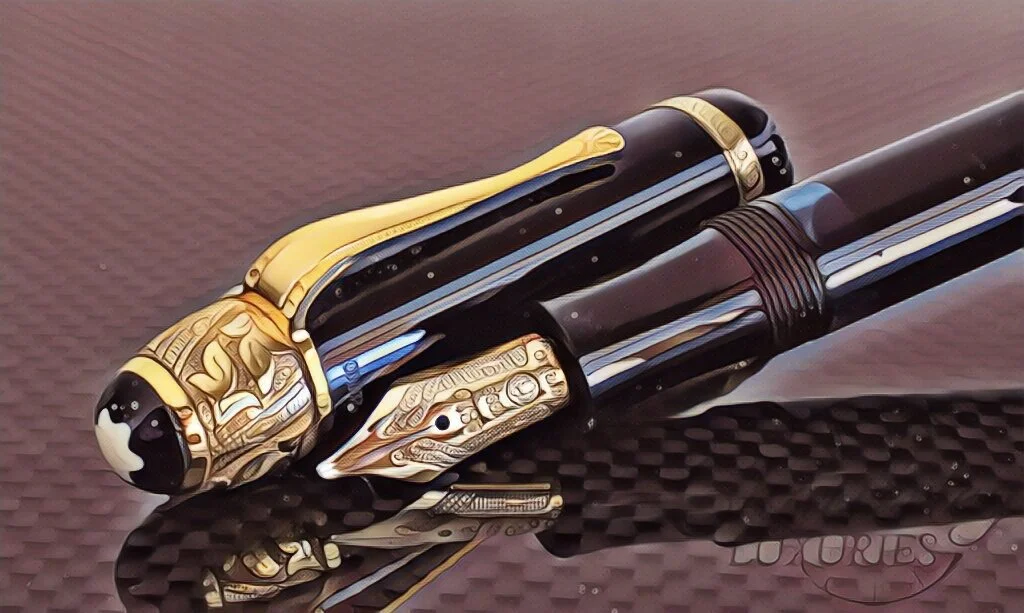
Stephanie dug into a bag that had been acquired in one of the shops, and while still searching, said, “Well, to help you in that endeavour, I got you a little something. While you were looking through Yves St. Laurent, I found these in Montblanc and I thought they suited you and your craft.” She handed her friend a parcel.
Charley pulled out a leather-bound notebook, not dissimilar to the type used by Aramis. The pages were lined but of a parchment quality that gave it an old-worldly feel. And then from a small box she lifted a refined fountain pen, with what appeared to be something like a snowflake embedded in a clear plastic resin at the top.
“O Stephanie, this is beautiful.” She pulled the lid off to reveal a tip finely made and designed to provide an even flow of ink from within the case itself. She leaned over and gave her friend a kiss on the cheek. Charley understood that the pen was expensive, likely in the hundreds of dollars, but she also knew that the cost reflected the special relationship they had developed in just a few days.
“I’m afraid I didn’t get you anything. I’m sorry, because you’re definitely worth something of great value …. like this,” she said, holding up the finely polished writing instrument.
“Charley, what you gave me - gave us all really - was an experience unlike anything I’ve ever had. There was love, tragedy, history, collaboration, one of this city’s great icons, England, a marvellous English woman, and in the end a Rembrandt. That’s more than enough for a lifetime. Thank you. Thank you. Thank you.” The women hugged in the busy restaurant as the tears fell.