
The Forest Secret - Chapter 9
It was one of the capital city’s shortest streets, but more fascinating, it fell almost under the shadow of the great Notre Dame Cathedral - a nearness that surprised the two women.
“Most people want to live a good distance from where they work in order to live two separative lives, but not Aramis,” said Stephanie.
“My editor back in New York believes that Caron had a love affair with cathedral,” noted Charley. “Maybe she was right.”
Rue des Barreswas developed in the 15th century and was only 150 metres long but they delighted in its quaintness, atmosphere of solitude in a huge city and especially the sense that one was walking back in time. It was constructed on a slight path inclining up from the river and the cathedral, giving an ideal view of the two great towers and the spire in those times before the fire. Terraces were everywhere in this St. Gervais portion of Paris.
“It should be one of this city’s most famous streets because of its beauty,” said the lieutenant in charge of watching Caron’s apartment until the investigation had been completed. “The trouble is that it is so short,” he continued, “and so it goes unnoticed.”
Caron’s apartment, when they at last entered, was much like the street itself. The windows, one floor-to-ceiling, were made up of multiple small panes, giving them an ancient quality that they could have been hundreds of years old. The four rooms of the apartment, not including the bathroom, were vast, high-ceilinged affairs that made the furniture appear miniature in comparison.
“Wow,” Stephanie said, her head almost turning a full half- circle as she took it all in.
“I know,” the officer added. “We wondered how a guide could afford such a place, but it turns out that it belonged to his mother and father and he inherited it once they passed. His entire life was lived in these walls.”
Charley quickly jotted that information into her small notebook and kept looking around.
“You will see that this is the main room,” the officer added. “Through there is his bedroom and through that door over there is his reading and writing area - a marvellous space. The ministry asked that I allow you full access to everything and that you could be trusted. So, I am heading down the street to get a coffee. May I get you something?”
They both declined and began exploring once he left.
“This is amazing,” Stephanie exuded. “Such a private man, largely unknown, and yet living in a place like this. Somehow it only adds to the mystery that is Aramis Caron.”
Charley nodded at the aptness of her friend's observation. Nothing about the old man seemed regular, which likely meant that there was much to discover.
They moved into the study and realized they had entered a whole other world from what they had just witnessed. Along an entire wall were floor to ceiling bookshelves stocked with volumes beautifully bound, in many languages, but all hinting of things beautiful and tragic, ancient and modern, revealing and mysterious. The desk felt as old as the building itself - solid, stately, intriguing and containing treasures that must have each carried their own story. It’s top held a magnificent magnifying glass, a pile of books mostly about philosophy, a pen set, fountain and ballpoint, that appeared coated with pearl, and an ancient lamp whose shade appeared as thin as oilskin.
Charley chose to sit in the chair, where Caron would have spent countless hours, running her fingers over the surface and edges of the desk and willing herself to fall into the enigma of the man who once occupied the chair.
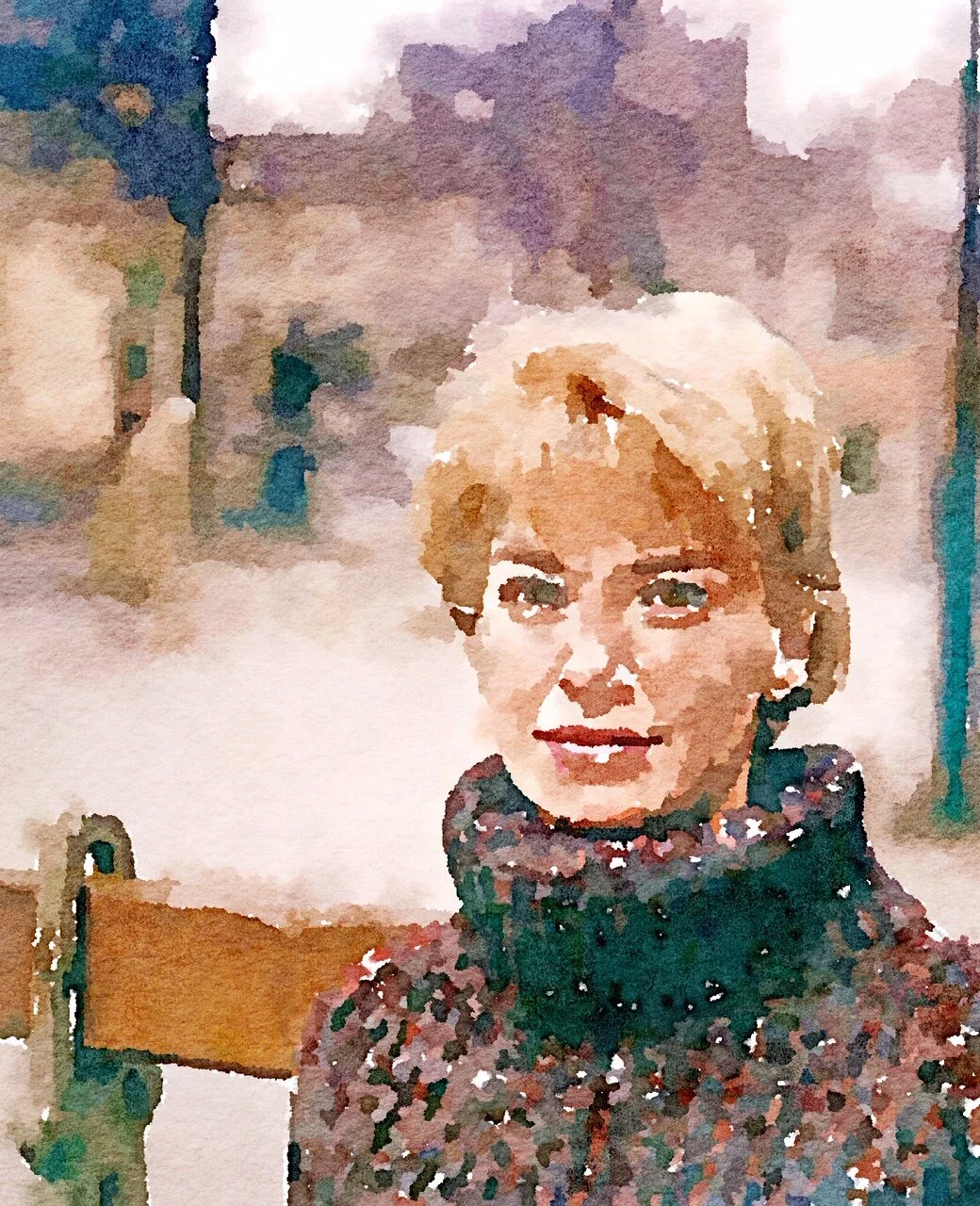
It was then she spotted it - the clue that would eventually unlock everything else. It was a portrait of a young woman - attractive, high cheek-boned and an intelligent look in the eyes. The painting was hung in a recessed portion between two bookshelves and around it were other paintings, drawing, sketches and architectural designs of Notre Dame Cathedral.
“Look, Steph,” she called out, now familiar enough with her friend to use the shortened version of her name.
“What’s up?”
“What does that look like to you?” Charley asked.
“O my God - like a shrine. It looks like a shrine.”
“Exactly,” Charley agreed.
Both women walked as in unison to stand before the painting. Portrait style and in an ornate golden frame, the figure was depicted in lush oil colours and the woman had a hint of smile on her lips. The background was clearly of the Seine, but whereabouts on the river couldn’t be deciphered. The subject of the painting had pixie like short hair and looked no older than thirty.
“Quite pretty,” the photographer whispered.
“Beautiful, I’d say,” Charley responded. “Listen, can you do me a favour? Phone the office on your cell and see if Denis is free to taxi over here. He’ll see things in all this that we would likely miss.”
Thirty-five minutes later, the researcher was looking at the same painting. “This entire room is a treasure trove, not just of Caron’s life but of Paris through the years. He must have inherited much of this from his parents and grandparents. Like this apartment, it all tells a story.”
“And the painting?” Charley urged, bringing him back to the purpose of his summons.
“Well, see that bridge there, over the Seine. There are 37 such spans but this one is clearly the Pont des Art. You can see by the landmarks - on the one side of the Seine is the façade of the Institute of France and here, on the opposite side,. is a portion of the Louvre. It looks to me to have been composed after the war.”
“How can you tell that?” asked Stephanie.
“That part of the institute was demolished to make way for modernization in 1958.”
Suddenly he stopped, moving his nose to within an inch of the canvas. “Well, well,” he said, in a spirit of discovery.
“What?” Charley urged.
“If you look closely, right here, you can spot the signature of the artist by the seam of her sweater.” He tilted his head and examined it again. “It was done by Claude Baudin, so we are definitely in the right era. He was one of the city’s most famous artists, known mostly for his painting of everyday life on the streets of the city. He rarely did portraits, so this is special. He died tragically in 1994, when struck by a car while crossing a street near the Champs-Élysées.”
Stephanie had been silent the entire time and when Charley looked at her the photographer was carefully scanning the contents of one of the bookshelves beside the portrait.
“Steph, can you get a picture of the painting?” she asked.
“Both of you, look at these,” she said in reply, as if not hearing.
The shelves were full of leather-bound journals all bearing the same distinct handwriting. “These were all written by him - Caron. There are dozens of them here,” Stephanie exulted.
On a whim, Charley scanned the shelves on the opposite side of the painting and found them equally full of similar bindings and entries. It was a treasure trove.
“Look, I should go.”
“What? Why?” Charley asked of Denis.
“You’ve got lots here to keep you occupied for days. Claude Baudin’s family started a foundation in honour of him, using the sale of some of his paintings to get it started. They keep an office not far from here - I’ve been there before. Let me quickly go there and see if they know anything about this painting and then I’ll circle back to you.” With a quick click of the camera on his cellphone, he caught the essence of the painting and was out the door before the women could say anything.
Smiling, Charley prompted her friend, “Why don’t you start on that shelf and I’ll do this one and let’s see what we discover.”
What they were about to uncover contained a world within worlds and a story within stories.